Tuesday, 29 March 2016

Sentry Monitors

Sentry monitors are a well-established technology. In societies where most security patrolling is conducted by cybershells they may even be regarded as being somewhat dated.

A sentry monitor is a worn device that monitors the wearer’s body temperature and heart rate. They may be encountered being used by human security guards and soldiers on guard duty.

If the monitor detects bio-signs concurrent with the wearer sleeping the monitor activates an alarm to wake the guard. If the correct code is not entered within the given time the monitor will transmit an alert to a control centre.

If the monitor detects bio-signs indicating that the wearer is drugged, unconscious, injured or dead it will transmit a more urgent alarm to summon help.

If the monitor is removed, either by accident or on purpose a security code must be entered or an alert is transmitted.

Removing a monitor and placing it on another person serves little purpose unless the correct reset code is known.

Sentry monitors are most common in Third Wave societies. In Fourth and Fifth Wave societies they may be worn by cybershell supervisors or operators. Security cybershells usually have an equivalent system that activates an alarm should the cybershell be disabled.

Saturday, 13 February 2016

RED Files

            In the movie “Red” there is a scene where a character visits the CIA archives. The archivist (Ernest Borgnine) presents him with a cardboard folder filled with heavily censored documents. It is possible that this was intended to convey how old the files of interest were. It does, however, suggest the interesting possibility that some files are of such a high level of secrecy that they are not put on computer, even on stand-alone (“air-gap”) systems.
 
 
            I will call these RED (Restricted External Documentation) files, although different agencies and organisations will doubtless have other designations or acronyms. A GM should feel free to invent a better or different term if they wish to obfuscate from the players the true nature of the file they may be after.

            Not all RED files will be an old jacket filled with papers. Some may be of more recent manufacture, their distinguishing feature being the use of a format not compatible with common computer storage media.

            It is likely that many files will be stored in a microform format. There are a variety of these and they may be quite unfamiliar to TS-era characters. They include:

            Microfilm. Microfilms may be available in a number of formats including 35mm, 16mm, or some deliberately unique or rare format. Microfilm may be in either cassette or spool format. Aside from the problems of locating and stealing a microfilm the TS-era character will have to locate/create a compatible projector or viewer.

            Microfiche. A microfiche is a transparent sheet upon which is reduced images of pages of text. It can be treated like a sheet of paper in that envelopes of them may be included in file jackets or stored in ring binders. A microfiche reader holds the microfiche between two pieces of grass and projects an image of part of the sheet on a screen. Microfiche viewers were once commonplace in libraries but by 2100 are likely to be very rare outside RED sections.
 
 
            Aperture cards. Aperture cards are a Hollerith (punched) card with a rectangle of microfilm included. These are used to store images or short documents. The Hollerith component allows for large numbers of files to be sorted or collated with relative ease. RED facilities that use aperture cards will obviously include machinery for handling Hollerith cards. Such machines are little more than a historic curiosity in the rest of the TS-verse.
 
 
            Whilst some RED files may resemble 20th century microform formats or paper pages the actual materials used may be more modern and less susceptible to degradation.

            Acquiring RED files may involve other obstacles for characters. As well as being in very secure facilities in the first place, RED files may include features to prevent them being removed. A possible system might be microscopic antennae embedded in the very matrix of the paper or film. This is an obvious evolution of the system used in many libraries and retail shops to prevent theft. When the antennae returns a signal transmitted by security scanners an alert will be issued. Similar systems may induce the self-destruction of files if they are moved too far from their authorized location.

Tuesday, 2 February 2016

Vehicles: RATS Transportation

I have been considering some of the practicalities of bringing tactical cybershells into action. A multi-legged system such as a Kumo-607 can probably move quite swiftly but will still be slower than a more conventional vehicle. Many tactical robotic systems such as cyberswarms and snakebots are smaller and slower than the Kumo so will also need some form of transportation. The human elements of a platoon will also need a means of transport.

The obvious solution is some form of armoured personnel carrier (APC). These will be in use in the TS-era and will be designed to transport a greater variety of passengers. Cybershells of all shapes and sizes will travel both inside the vehicle and clinging to its exterior. Various nooks and crannies will be used for swarmhives. RATS on the outside of the vehicle will effectively act as additional weapon turrets.

The APC is not the only option of ground vehicle. A friend of mine often remarked that if troops had an adequate level of body armour then armouring their transport was not such a high priority. RATS can be transported in trucks, pickups and SUVs, these vehicles themselves likely being driven by an AI. This option is particularly attractive in scenarios where a military unit does not wish to overtly advertise its movement. If the vehicle is disabled by some means the unit simply commandeers a nearby civilian vehicle and occupies it. Perhaps the military driver program can be plugged into other vehicles and includes a “hot-wire” suite to override civilian vehicle security systems. This would make such a driver program attractive to some of the criminally inclined!


A squad does not all need to travel in a single vehicle. Suppose we provide the unit with a number of small tracked vehicles similar to the minirip or the slightly larger ripsaw? A single minirip could carry a Kumo-607 type RATS or a human in a battlesuit and still have room for a number of smaller systems and additional stores. The ripsaw could carry a couple of large RATS and a human passenger in the seat. Or the seating space could carry additional systems or stores. In effect we are considering something along the lines of a tracked vehicle that serves as a warhorse/packhorse that the combat system can ride to the battle and return to for transport or extra ammunition/equipment. The vehicle itself would have its own AI and possibly some armament. This allows the vehicle and its rider to act as a team. For example, several Kumos ride to a building on their tracked carriers. While they dismount to search the building or climb up its outside the carriers establish a defensive perimeter and assume overwatch.

Battlesuit Androids

           I’m indebted to a friend of mine for reminding me of this concept.

           In one of Gene Wolfe’s “Book of the New Sun” series Severian encounters a spacesuit with an advanced AI. The suit can move around and manipulate objects without an occupant. It is effectively a hollow centred robot and resents when Severian has occasion to wear it. The GURPS sourcebook for the New Sun series calls this an “Iron-class android”.

           A TS-era battlesuit has its own AI systems. It has sensors that the AI is capable of accessing. It probably has actuators to augment the wearer’s strength. It is therefore quite possible that many battlesuits can move around without a human occupant and can be used as cybershells for infomorphs.

           This has a number of potential applications. When a military unit is in action it will be more difficult to pick off the human controllers. Some of the battlesuits will be empty. If a soldier’s battlesuit is badly damaged he may be able to move into a nearby spare. If a soldier is unconscious or badly wounded the suit could evacuate him. In a SWAT scenario a rescued hostage or prisoner could be placed in a suit and the suit used to move them to a holding area. If a character is not in a battlesuit and is attacked they may be able to call one to their assistance from nearby. The latter idea is used a lot in the Iron Man films, Tony Stark’s suits automatically dressing him. TS-era battlesuits will have more modest abilities and need to be put on in the usual fashion. The potential of hacking a battlesuit or advanced spacesuit to infiltrate a location is possible, although military equipment such as this is likely to have very potent protective software.

Thursday, 28 January 2016

Space Habitat: West Sphere and Leisure.

           According to some of my reading a spherical space habitat is the optimum with respect to containment of air pressure and mass-efficiency at providing radiation shielding. The shape also the likely result of construction methods such as the bubbleworld technique. The downside of a spherical habitat is that only a small proportion of the interior will be at maximum centripetal gravity.

           My solution to this, the West Sphere, is to construct a cylindrical surface within the interior of the sphere. The following illustration depicts a 2.23km diameter sphere with a 1.78km diameter cylinder within. If the sphere rotates at one revolution per minute the centripetal gravity on the inner surface of the sphere will be the equivalentof 1g. The cylinder is 1.35km long in this illustration so the potential 1g area is more than 7.5 million square metres.
           The volume of habitat under/outward of the cylinder floor will be subject to higher centripetal forces of between 1g and 1.25g. Such g levels are tolerable for short periods of time but these areas are probably not suited to long term human occupation. Instead the higher g levels will be used for a number of other purposes. Drainage and sewage processing for the living areas is an obvious application. Many sections of this area may be used for storage. Many automated industrial processes could be located in these levels. It is possibly that some industrial processes might be facilitated by higher gravity levels. An interesting application for the higher g levels is for gymnasiums and exercise areas. A number of jogging and cycling tracks may be located in these levels. Tracks at differing levels may be interconnected by ramps so athletes can vary how much of their training is at higher gravity levels.

           The spherical habitat will be spun with one pole towards the sun. The solar pole will be shielded against radiation by a mass of rock. The anti-solar pole will be provided with windows and shutters. External mirrors will reflect sunlight through these windows and onto the inner surface of the cylinder. Somewhat confusingly, sunlight comes from the anti-solar end of the habitat! The shutters will allow the light level to be varied and could be used to simulate a day and night cycle. It is possible in some habitats no attempt will be made to simulate night and day. In some parts of the Earth humans function very well with months of constant daylight. Housewives in Reykjavik do their gardening in the middle of the “night” so it is possible some habitats will not bother with nigh time, or at least not full levels of darkness.

           The main docking area for spacecraft is likely to be situated at the solar pole near the axis. Visitors will initially be weightless. To reach the cylinder surface they will have to travel down the inside of the sphere at the solar end, possibly using some form of funicular. The lower the carriage gets the heavier they seem to become.

           Alternately the visitor may travel down the zero g central axis of the habitat. This will be a rapid route for moving passengers or freight to locations on the cylinder surface. A number of possibly transport options can be used here, ranging from zero g trains or cable cars to simple tubes were that individuals can simply free-fall (or get blown) along. A key points tall elevator towers reach up from the cylinder surface like the spokes of a wheel and intersect the central axis, allowing travellers to descent or ascend.
           The gravity gradient of the habitat allows for a number of novel leisure activities. Fitness training in the higher g levels has already been described. The lower gravity levels above the cylinder’s surface allow for some interesting airborne sports. Manpowered flying machines will be quite practical, providing the flyer does not descend too low. Flight by flapping a pair of strapped on wings is also possible. Batsuits, such as worn by modern parachutists (above), could potentially stay airborne for hours at a time if flown competently. The elevator towers described above are likely to include various flight centres and rentals on their intermediate levels.
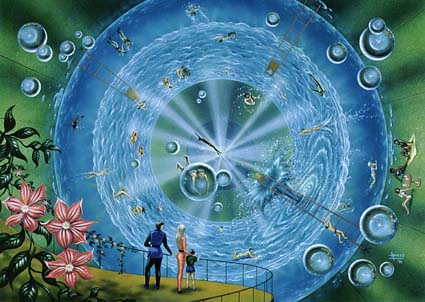
           An interesting proposal for the space habitat is the low-gravity swimming pool. This would take the shape of a torus-shaped trough of water of a smaller diameter than the habitat. This will be at the anti-solar end of the habitat so that it does not intersect the axial transportation systems. You will have to ascend to go swimming. The pool may rotate at the same speed as the space habitat or be spun at a slightly faster rate, depending on its diameter and the desired surface gravity. Swimming in such a pool will be a novel experience since the water surface will curve upwards. The lower gravity will have a number of interesting effects. If you bounce on the diving board enough you can fly straight upwards and dive into the water above your head! Lower gravity means that sports such as water polo will become less taxing and possible for a greater variety of players who no longer have to use most of their energy staying above the surface. In addition, or instead of the torus-shaped pool some facilities will include a large “bubble” of water at the zero g axis of the habitat. This “pond” will allow swimming in zero gravity. Gravityless swimming is also without buoyancy so there is a potential danger that someone swimming in the “pond” may become disorientated and drown before they can reach the spherical surface. To counter this the pond will be interlaced with brightly coloured guide lines which also incorporate airlines and breathing mouthpieces at frequent intervals. These lines also replenish the pond by pumping water into it. Without this system the pond will diminish as splashed water descends to the surrounding torus pool. It is possible to swim all the way across the pond and then fall/dive into the torus pool. This will bring a whole new significance to the lifeguard’s command of “no bombing!”
           It is not just sports that will take on new aspects in a space habitat. Ballet and some other dance disciplines in reduced gravity will have many new facets, with dancers leaping dozens of metres and staying airborne for seconds at a time. To exploit this ballet theatres in habitats will be built at the top of towers or tall buildings.


Tuesday, 26 January 2016

Greyhounds, Couriers and Packets.

Greyhounds (also known as Couriers or Packets) are relatively small space vessels. Greyhounds are used for the rapid transport of very high value individuals and materials. Their passenger accommodation, if any, is very basic and passengers are typically transported in nanostasis. Most of the ship is taken up by the drive, fuel and reaction mass. The purpose of the greyhound is to rapidly move objects from one place to another. Greyhounds vary considerably. Some can carry a small party, others just one or two people and others can only carry packages smaller than a baseline human.
Some greyhounds may be piloted by a human but AI piloting is more common. Many things that are moved by greyhound are confidential and the memory of an AI pilot is easier to erase.  Information too sensitive to be broadcast may be transported on a data core in a greyhound. Greyhounds may incorporate various systems to prevent their cargo being intercepted, tampered with or stolen.

Tuesday, 19 January 2016

Weapons: 40x225mm Super Forty

The CTAI CT2000, 40x225mmCTA Super Forty is a rival to the 50mm Supershot and appears currently to be the preference of the USMC and British Army. The Pyramid article suggests that it will arm IFVs and other vehicles till 2050. Given the British tradition of “making do” and defence cuts it is likely vehicles with these weapons are still be “soldiering on” in 2100. US-made vehicles with these weapons may have been given to allied nations as military aid.
The Super Forty fires 40 x 225mmCTA rounds with a plastic case. A version of the Bushmaster is offered that fires this round or 30 x 176mm or 30 x 170mm cannon rounds. This system is often referred to as a 30/40mm and this term may be used for other weapons of this chambering. The CT2000 had a linkless triple-feed system. The Bushmaster Mk44 is 343lb; Rof: 3 or 7; Dual belt feed.
            Apart from standard ammunition, CTAI also designed a guided APEDS-CLGP round, which fired a saboted, armor-piercing tungsten projectile with a HE charge. This laser-guided 25mm dart was modified from the submunitions of the British Starstreak surface-to-air missile. By the TS-era homing ammunition will doubtless have been developed for this cannon.
Name  Ammo  Damage  Acc  Range  RoF  Ewt  WPS  VPS  CPS  Pow  Notes
CTAI CT2000  APFSDS
6d x 11(2) 8
4,500/18,000
  6
  725
4.0
 0.015
 $110
 9kW


 AHEAD
6d x 6(0.5) plus 3d[4d(2)]
7

3,500/9,000


4.8


$110


[1]

 
APEDS-CLGP
6d x 6(2) plus 1d[2d] cr ex
7

4,000/12,000


4.2


$833


    HEPF6d[4d] cr ex   7 4,000/10,000   4.8   
    [2]

 
[1] AHEAD ammunition is effectively a shrapnel shell (HT 4e p.173) that can be programmed to explode at a range set at the moment of firing. It is primarily intended to engage airborne targets. The 3e Damage stat above is rather unrealistic for a round of this type. Explosive content would actually be a modest ejection charge. I have no specific data for the 30/40 AHEAD round. Online sources claim a 30mm version of the AHEAD contains 150 pellets but this may be confusion with the original 35mm round containing 152 tungsten pellets. 6d x 6(0.5) pi++ should be considered the KE damage from an intact shell. Using the rules in HT 4e p.166 & 172 based on 6d x 6 damage the pellets of an AHEAD are 3d(2) pi; RoF x 150; Rcl 1 The pellets get an armour-piercing modifier for being tungsten and high-velocity.
[2] The original table did not include any explosive round for the Super Forty. The HEPF is a programmable-fused airburst round based on the stats for a 40mm shell, reflecting improved explosive compositions in the TS-era.