Thursday, 19 January 2017

Firefly and Caccolube for Car Wars

             In 1944 two German divisions were ordered to move from the south of France to oppose the landings in Normandy. Each division had several thousand vehicles so gasoline stations along the route were used to keep them fuelled. Many of the attendants of these stations were members of the French resistance who had been provided with devices codenamed “Firefly”.
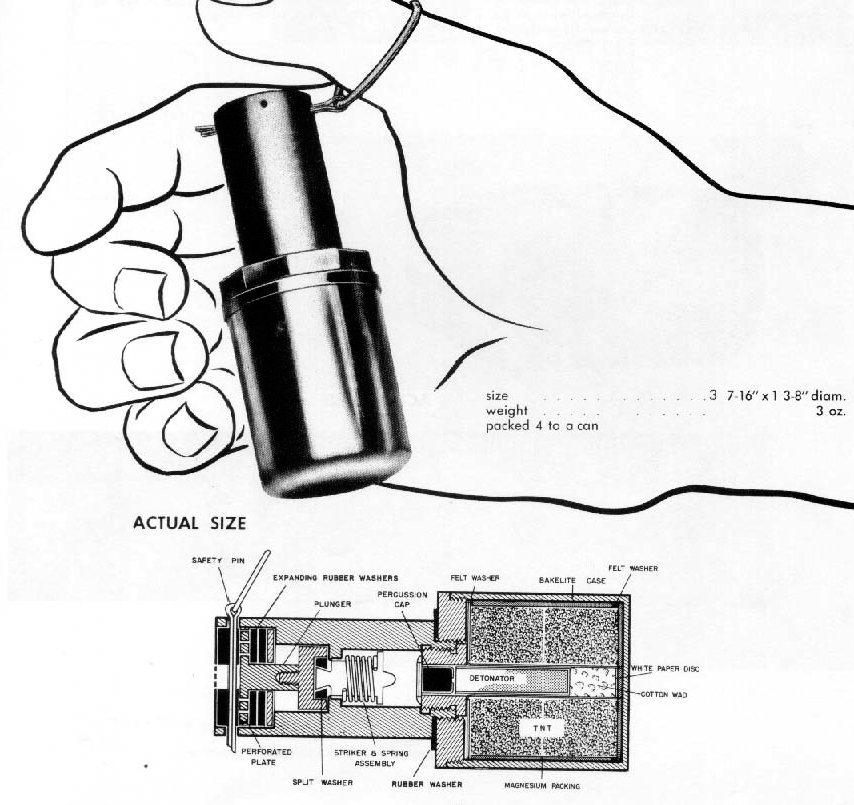
 
             Firefly was a small device that could be surreptitiously introduced into the fuel tank of a vehicle via the filling port. Once immersed in fuel rubber components of the device would react with the gasoline. Depending on temperature, two to seven hours later the firefly would explode, rupturing the fuel tank and igniting the fuel. If the vehicle kept moving it would usually leave a trail of burning fuel. If, understandably, the drive braked to find out what had happened the vehicle was likely to catch fire. Vehicles such as tanks were likely to become blazing wrecks before the crew could escape. The consequences for the rider of a motorbike who had his fuel tank explode between his legs were unpleasant.

             The use of firefly prevented hundreds of tanks, trucks and other vehicles from reaching the forces opposing the allied landings.

             Each firefly weighed 3 ozs. A safety pin needed to be removed before it was placed in a fuel tank (a ready action). Firefly were shipped four to a can and required assembly before use. Detonation required a chemical reaction between the fuel and the rubber washers in the device so it had to be immersed for it to work.

             A modernized version of the firefly might become part of a Car Wars campaign. Sabotaging the enemy’s vehicles with fireflies may be a plot objective. Unlike 1940's vehicles, modern vehicles may have locked fuel caps, or more sophisticated defences and circumventing these by some means might be necessary. In Car Wars terms an exploding firefly should be treated as a breaching hit to the gas tank with the same chance of causing fire as a standard flamethrower hit.

             Firefly is entirely non-electronic so may avoid detection from sophisticated security systems. For obvious reasons it is of no use against electric vehicles, just those with gasoline and diesel engines.

             A possible drawback is that it is very difficult to predict when firefly will detonate. The user may want to ensure that his enemy is in the vehicle when the fuel tank explodes and it catches fire. An electronic or clockwork timing device could be added to the charge, providing it still allows the bomb to be slipped down the filling port. Alternately, a mechanical flow meter could be fitted to react to movements of the fuel as the vehicle accelerates or decelerates. The action of gasoline on rubber could be used to impart a delay in the mechanism become active. Radio-command detonation is not really practical for a device floating in fuel in a metal container inside a metal car body.

             A field improvisation of firefly can be made by securing the safety lever of a grenade with a rubber band or electrician’s tape. The fuel eats away at the rubber or adhesive until the lever is released. The problem with using this on vehicles is finding a grenade of a diameter that can pass through the filling port! In the movie “Collateral Damage” Arnold Schwarzenegger creates a time delay by sprinkling fuel on a rubber band securing a grenade safety lever.
             A contemporary of firefly was “caccolube”. This was designed to be introduced into the engine oil rather than the fuel. Caccolube was simply a condom containing a gritty compound, so would be easy to fabricate. The oil acted on the rubber to release the compound into the oil supply. The compound then abraded the internal parts of the running engine until some component failed. Accessing the oil system may be more difficult but oil caps are less likely to be lockable. Instead of an abrasive an updated version of this might use some form of polymer flakes that does an even more effective job at clogging the engine. Alternate chemical anti-material substances include combustion modifiers and fuel contaminants (for gas tanks), lubricant contaminants, viscosity-enhancing agents and depolymerization agents. Other contents, such as nanobots, are possible.

             Firefly and caccolube are of less use in Transhuman Space. Whilst vehicles that use gasoline or synthetic gasoline may be encountered, electric vehicles or those using alcohol, hydrogen or liquid oxygen are more common, especially off-Earth.


Wednesday, 18 January 2017

Ether Superiority.

During the 20th century it was believed that conflicts were fought in the air, on the land and in the sea. By the 21st century it was recognized that a fourth environment, the electromagnetic spectrum was also significant. Gaining dominance in the EM spectrum, or “ether superiority” might be pivotal in future conflicts.

As America invested in networked battle communications and remotely controlled weapon and reconnaissance systems potential enemies invested in jamming devices and other means of electronic warfare.
 
In Jan 2015 an article with the following passage was published. 

“According to our Ukrainian partners, commenting on the latest ATO news, and referring to the "intercepted data from reports of the Russian army", today another division of the Russian army was destroyed near Lugansk...
I want to briefly explain to the Ukrainian colleagues, what is the modern Russian army, and what would happen, if it would come to visit them in reality, and not in their wet dreams.
Firstly, today we use digital radio communication with local encryption. You can intercept it, but you cannot decipher it. The code changes in 50 minutes, an hour, an hour and twenty-two minutes - on arbitrary unpredictable schedule. Ukrainian military and the armed forces of Novorossia are using an old analog model, which you can listen to. And the Russian army now has communications which was previously only on secure communication lines, - you can only hear the crackling and a characteristic murmur.
Secondly, if the Russian army appears in front of UAF, it will be easy to determine.
The first sign - failure of all means of communication, full discharging of batteries in vehicles, tanks and other equipment, at the same time, discharge of batteries in mobile phones, the targets, and radio stations. Then, there is a rupture of electric circuits throughout all the equipment - all of it. This is EMP. All engines stall, no way to restart. This is how the system "X" works (in order to protect the author we do not specify the name), with a range of up to 20 km.
Second - complete failure of all systems using LCD monitors, the failure of all target-locating devices of the air defense system. This is how the complex "Altair" works (this is a known complex in the world, we can name it).
Third - a failure to deploy any kinds of guided missile weapons - from MANPADS to PTURS [anti-tank guided reactive missile]. Upon launching, the ammunition liquidates itself. This is a battalion complex "Z" - on the basis of MTLB [multi-target light armored transporter]. Range - 15 kilometers.
Fourth - it is impossible to use a drone and low-flying aircraft. Their on board electronics will fail. This is system "Y". Then there is a complex "Avtobaza", which can forcibly land a drone.
What will happen next? Dozens (hundreds, if necessary) of the latest combat helicopters, flying over all the roads, start hunting for single armored vehicles, trains, cars. Railroad is paralyzed, bridges blown up. The lights go out on the home front - electric stations are out of service. Civil and military headquarters on the home front and separate leaders simultaneously are liquidated by the recon-subversive groups.”

The Russians are never above a bit of misdirection or disinformation so the above may not be an exactly accurate picture of actual capabilities. Complex “Z” seems a little redundant if System “X” has already hit everything with an EMP, for example. The article does give a nice thumbnail of weapons that may possibly be used in a Third to Fifth Wave conflict.
Currently the US is making considerable use of remote controlled systems and extensive communication networks and is very vulnerable to electronic warfare. By the TS-era we will see greater use of autonomous unmanned combat systems. Compared to current systems most TS-era electronic systems will be considerably more resistant to electronic attacks and hacking, particularly if they are military or state of the art. Some systems, however, may be impossible to protect. Weight considerations will limit the shielding that can be used by cyberswarms and small flying robotics, for example.
Without the capability to constantly micromanage units command posts may have to permit humanoid troops a great degree of initiative than some armies have previously been used to.

On a more localized level squads and platoons may need to find ways around the jamming of their communications.

Relatively static units may make use of hard-lines. Lineman and telephonist may persist as military specialities. Doubtless new technologies such as robotics may change how such lines are lain.

For more mobile forces methods such as hand signals will continue to be used. Some RATS may not have appendages suitable for hand signals, however. Laserphones are another possible answer but are restricted to line of sight and good visibility. They also need to be aimed accurately at the receiver unit, which may not be practical when elements are fast-moving and attempting to remain camouflaged. Signalling with flashing lights may be more practical. Companion AI systems can automatically convert speech into coded flashes and back again. Smoke, dust and weather may affect the use of these.

Sound is another alternative to platoon level radio communication. Visual and audible signals are how most infantry in the Second World War communicated, after all. Whistles are useful and lightweight, but their utility may be limited on a noisy battlefield. Squads may make use of bullhorns or similar devices. For clarity and security an updated version of bugle calls may be employed.
Platoons and squads may once again employ messengers to communicate with their elements and higher formations. The 2100 version of a messenger may not be a runner or dispatch rider. Small autonomous robots may be employed instead.

Monday, 16 January 2017

Weapons: Vesicant Pen

The vesicant pen is an ingeniously nasty device that may be found on these pages. It may be encountered in Transhuman Space (TS) or other scenarios.
The vesicant pen looks like a large felt-tip pen or paint dauber. It contains a quantity of blister agent. For obvious reasons, the cap is airtight and this may be a recognition feature fr those that are aware such devices exist. The blister agent used is clear and transparent but somewhat oily. It may stain absorbent materials or interact with some woods, plastics or varnishes.
 
 
In game terms the blister agent is treated as mustard gas (p.B439). The actual formula may be different to actual early 20th century mustard gas. For example, the updated blister agent remains liquid and volatile down to 14 °F (-10°C) and includes necrotic enzymes. TS-era blister agent is probably odourless. Characters or creatures with an abnormally sensitive sense of smell may smell something like garlic, horseradish, mustard plant or mown hay. They may not recognize this as a threat and curiosity may be tempt them to inhale more.
The simplest way to use the pen is to paint the agent on something that the intended victim is expected to touch. This can create an unpleasant but relatively localized wound. The pen may also be used to apply the agent to blades, arrows, punjis etc.
Using the blister agent for a respiratory effect is a little more difficult since the capacity of the pen is limited. Several minutes would be needed to contaminate a relatively small room. Would be users should bear in mind that blister agents are heavier than air.
More practical is to apply the agent to something the target will be expected to smell or have near their nose. If an individual is in the habit of sniffing marker pens the pen can be left where they will find it. Alternately the agent can be applied to the inside of a facemask or space helmet.

Friday, 23 December 2016

Vehicles: Cunegl Moon Hopper

A wide a variety of vehicles have been called “moon hoppers”. The name is perhaps most apt for the Rieter Cunegl.

The cunegl is based on the observation that the hopping of a kangaroo is a very efficient means of locomotion. When hopping at speed the kangaroo’s body works somewhat like a pogo stick. As it lands its energy is stored in the tendons of the legs. This stored energy is utilized to make the next hop. Using this system the kangaroo can hop at speed for considerable periods of time for very little energy expenditure.
The passenger model cunegl resembles a chair mounted on two mechanical legs. Each leg has three sections and ends in a pad that is designed not to sink into loose moondust. Each foot also has retractable claws for better purchase on rocky terrain.
Mounted on a pillar above the chair is an array of four thrust nozzles, arranged to point outward and downward. Thrust from the two rear nozzles assist the vehicle when it begins hopping. Thrust from the forward nozzles brakes the vehicle, even when it is not in contact with the ground. Firing the nozzles in various combinations can alter the trajectory of the vehicle during a leap.
Hopping behaviour is controlled by the vehicle’s computer. The driver merely has to determine course and speed. A lidar array scans each potential landing spot and configures the legs for the optimum configuration for either landing or another bound.
In the low gravity and airless environment of the lunar surface each bound of a cunegl can take it scores of metres at a time. These highly efficient vehicles can travel hundreds of miles across difficult lunar terrain on a single charge. The vehicle’s modest energy needs are easily met by a small solar panel.
Prospectors favour these vehicles since each hop takes them dozens of metres about the surface, giving an good view of surrounding terrain. In addition to the manned vehicle the same locomotive system is used on a variety of cybershells.
A wide variety of alternate names for the moon hopper may be encountered. These include “moon bunny”, “moon-roo”, “bounder” and “boomer”.

Thursday, 22 December 2016

Weapons: 8mm Flechette Rifle

The 8mm flechette rifle is a weapon that is usually encountered in the hands of security guards. Users favour the weapon for its flat trajectory, high hit probability, low recoil and effects on unarmoured and soft-armoured targets. Its limited range and poor performance against hard armoured targets have precluded it from military adoption. Their minimal effects against hard armour can be exploited if friendly forces are armoured and the enemy is not. American insurgents and some criminals have also made use of stolen weapons.
The 8mm diameter polymer cartridge is straight-walled other than a slight bottlenecking at the end used to headspace the cartridge. Each cartridge contains a sabot that holds five 1.5mm steel flechettes. The light weight of the flechettes gives them a muzzle velocity in excess of 1,100 yards/ sec. At short ranges penetration is high and trajectory is effectively flat. At longer ranges the projectiles rapidly lose velocity and will be affected by cross winds.
Although they are commonly referred to as “flechette rifles” the weapons that use the 8mm round are usually of SMG configuration. Barrels are effectively smooth-bore, having a slow, shallow twist to aid sabot separation and flechette dispersion. The 8mm round is well suited to a simple blowback mechanism. The simplicity and low cost of such weapons is another feature that recommends them to security forces. Typically a reflex sight (+1 to Guns skill) is fitted.

Guns (SMG) (DX-4, or most other Guns at -2)
Weapon
Damage
Acc
Range
Weight
RoF
Shots
ST
Bulk
Rcl
LC
8mm Flechette Rifle
2d+1(2) pi-
6
200/900
4/1
12 x 5
32
7
-4*
1
2
Real world note: Relievable information on the terminal effects of flechettes has been hard to come by.
The original claim of the SPIW project was that flechettes that hit denser materials such as flesh would bend, dumping all of their residual energy into the target.
Another source claims that the tail of the flechette tends to stabilize the projectile in flesh too so flechettes are not prone to tumbling, giving poor energy transfer. Evidence for bent flechettes, it claims, is from wounds inflicted by multiple flechette rounds fired from recoilless rifles, tank guns and artillery. Flechettes were bent by the stresses of firing, not impact, it is claimed.
During the ACR rifle trials it was claimed that the flechettes used by two entrants “fishhooked” reliably.
Terminal effects are more about damage than just energy dump. Even if the flechettes do bend and tumble the real question is the rate, depth and damage that occurs as they do so.
Flechettes lose velocity at a rate of 114 yards/sec per 100 yards.


Attrapeur

The attrapeur is a robot used by a number of police and security forces. It was first used with great success in the Paris student riots four years ago. An attrapeur has four multi-sectioned legs of about a metre length which join onto a compact, flat body of less than a third of a metre long. An attrapeur flipped on its “back” will simply pivot its limbs until they are under it again. The narrowness of its limbs and body make it a difficult target to hit with gunfire. Its appearance and movements are disturbing to severe arachnophobes.
When not in use the attrapeur folds itself up into a compact volume. Even vehicles with relatively limited cargo space can carry a number of attrapeurs.
The attrapeur can run at great speed. An attacking attrapeur will run to a target and seize them around the thighs with its forward limbs. Its body will then flip upwards and the rear limbs will wrap around the target’s arms and torso. This usually immobilizes the target. The attrapeur broadcasts its location to the command centre. A flashing LED and audible beacon is also activated to assist officers locating the attrapeur and its prisoner.
In many English speaking countries the attrapeur has gained the alternate name of “wrapper”.

Friday, 22 July 2016

Weapons: Burundi Broiler

 I let my gaze wander around the apartment. A water jug was on the table near the window. As I glanced at it the water suddenly began to violently bubble. No sooner had I began to marvel at the strangeness of this when it again settled. I looked towards the chairman to see if he too had witnessed the phenomenon.
He was already quite dead. His head lolled to the side, his eyes milky like those of a fish from under a grill.

The Burundi broiler first appeared in 2094 in the African state of the same name. While majority of evidence suggests that it was a local invention there is some doubt about the veracity of this. Within a few months the TSA was producing copies of the Burundi broiler. It is currently recognized that many broilers in current circulation that appear to be of TSA manufacture have other origins. Identifying the source of a broiler is problematic since the components have assembly numbers but no serial numbers or other distinguishing features. Broilers are apparently assembled by unskilled labour using a V-tag system. Only when a commercially available component has been used to repair a broiler is there a hint of the weapon’s history.

The broiler is a maser weapon firing a pulse of coherent microwaves. It resembles a rifle with a short but broad cylindrical barrel. The broiler is a weapon of specialised application. The pulse from a broiler is blocked by metal. The weapon has very little effect on military cybershells or battlesuits. Radiation suits, many space suits and various other protective outfits also provide some protection. The broiler has a low rate of fire and a relatively short range compared to more conventional weapons.

Unlike a laser beam, the maser pulse is invisible. The weapon is also relatively quiet. Listeners within a few yards of the firer may notice a humming noise as the weapon fires. Many will not recognise this as a weapon discharge and attribute the noise to some other machine or appliance. The maser pulse is not affected by smoke and will pass through glass. The pulse may interact with fog, causing swirling patterns to appear near the pulse’s path. Interaction with fog has no effect on the performance of the weapon. The maser pulse cannot pass through large volumes of water. Heavy rainfall may reduce the range of the weapon.

The maser pulse is highly effective against unprotected living tissues. This, and the weapon’s low firing signature make it a useful assassination weapon. The Burundi broiler is an uncommon weapon and unlikely to be acquired without underworld or covert connections. A few have been used by American insurgents. Possession of a Burundi broiler is generally highly restricted or illegal.

The Burundi broiler can be an effective weapon against equipment designed to receive microwave transmissions. This includes communication relays and most cybershells. This capability has seen the broiler used by some Luddite and vandal organisations. The broiler will often destroy or badly damage the communications capability of a targeted machine or vehicle. Cybershells of SM-7 or smaller will often take physical damage from the resulting power surge.

In 2096 the murder of journalist Tiffany Chen with a broiler triggered a media frenzy about their use. It was during this time that the slang term “curdler” became popular. This particular media crusade lost steam when a number of investigating reporters met the same end. Crimes committed with broilers still attract a high level of media attention and this often pressures law enforcement to prioritize them.
Beam Weapons (Rifle) (DX-4, other Beam Weapons at -4, or Guns (Rifle)-4

DamageAccRangeWt.RoFShotsSTBulkRcl
Burundi Broiler6d special12300/44011/C15(4)8†-41

Armour protects normally. Metallic armour or other protection that blocks microwaves adds +8 to the active defence roll or saves on an 8 or less if no active defence roll is made.
Damage that penetrates armour causes triple damage to living tissues and electronic equipment. Non-living targets take half damage.
In addition to any physical damage a hit from a broiler also causes an EMP pulse that will disrupt electronics. This occurs on a roll of 14 or less, subtracting 1 for each 20 points of combined DR and HP the target has. Each point the roll succeeds by disables the system for 2 secs. A critical success or success by 10 permanently disables the system.

The stats above are for a basic Burundi Broiler. Usually accessories such as a bipod, telescopic sight and targeting computer will be fitted. A basic weapon costs upwards of $2,500. A takedown version that can be broken down into between four and six sub-assemblies costs $1,200 more.